Networking
The problem with traditional networking events.
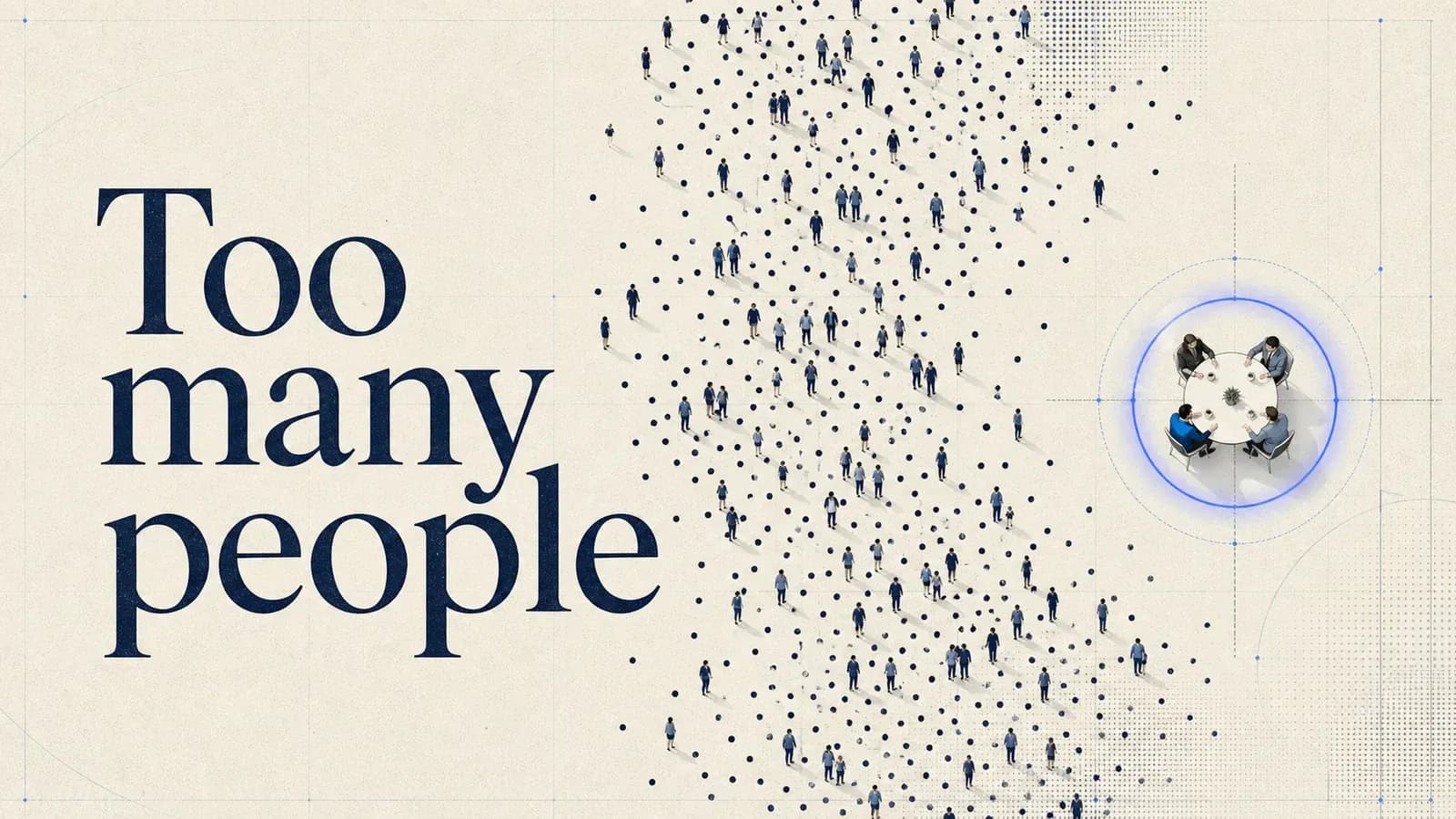
Most networking events are optimized for the wrong outcome. They look productive (a roomful of professionals, a sponsored bar, a stack of name tags), and they feel like work because they are work. The catch is that the work has almost nothing to do with building real business relationships.
If you have ever come home from a mixer with twelve business cards and zero memorable conversations, you have felt the failure mode. The format is doing exactly what it was designed to do; the design just does not lead anywhere useful. This piece is a diagnosis of what specifically breaks, and what to use instead.
Failure mode 1: the mass-room problem
When the room is too big, conversation cannot go anywhere. You have ninety seconds before someone else angles in, the music is a bit too loud, and the social contract is to keep moving so you can each maximize your card count. Big rooms reward surface signals (tall person, good jacket, confident first sentence), and they penalize the people doing the most interesting work, who are usually deep in a problem and do not need to perform.
There is a cognitive ceiling here too. The anthropologist Robin Dunbar's research suggests humans can hold about five close people in working memory in real time. Past five, names blur. Past fifty, you stop tracking individuals at all and start pattern-matching on roles ("the VC", "the founder in hospitality"). That is the moment the room stops being a room and becomes a crowd.
Failure mode 2: pitch energy ruins the table
The second failure mode is when the room is full of people who all want something. Investors prospecting, salespeople qualifying, founders fundraising. Every interaction has a target, which means no one is fully present. The table tilts because everyone is angling, and trust (which only forms when there is no immediate payoff at stake) cannot take root.
This is the unspoken reason most senior operators stop showing up to networking nights after a certain point in their career. The math gets worse: they want fewer, deeper conversations, and the format guarantees the opposite.
Failure mode 3: the wrong selection filter
Most public networking events are filtered by who decided to come, which is the worst possible filter. The people who consistently attend mixers are disproportionately the ones who need them, early in a career switch, between roles, or selling. The people you would most benefit from meeting are mostly home, because their relationship pipeline already works.
Curation is the missing ingredient. A small, intentionally chosen group (different industries, similar season of life, complementary intent) outperforms a self-selected crowd by an order of magnitude. We go deep on the composition question in What makes a great dinner-table conversation.
Networking format scorecard
Not every format is broken in the same way. Here is how the common ones stack up across the dimensions that matter.
Curated dinners and 1:1 coffees do the actual work of relationship building. Everything else has its place, but mistaking it for that work is how a year of networking leaves you with a long list and a thin Rolodex.
What works instead: the small-table format
The format that consistently outperforms is unglamorous on paper: six people, one table, three hours, no name tags, no facilitated icebreakers. The constraints are the feature. At that size everyone can hear every story without it splitting in two. Three hours means you can outlast the small-talk phase and reach the second-drink hour, where real conversation lives.
Why this works is covered more fully in Why small groups beat big rooms. The short version: a dinner table forces the right size, the right pace, and the right intent. You cannot seat ninety people at a six-top, and that is exactly what makes it useful.
If you have to attend a big event anyway
Sometimes the conference, the gala, or the customer party is required. A few field-tested tactics for getting actual signal out of a format that is not designed for it.
- Pre-pick three people you actually want to find. Skip everyone else.
- Skip the keynote, work the hallway. The talks are recorded; the hallway is not.
- Anchor to a small group. Find the cluster of three or four people who look mid-conversation and stand near them, not the bar.
- Suggest the after: "a few of us are grabbing dinner after" is the highest-leverage sentence at any conference.
- Inside 24 hours, send one specific note to the two people who actually mattered. "Great to meet you" disappears. "Loved your story about the second hire" lands.
Common questions
- Are any traditional networking events worth attending?
- Industry-specific breakfasts (20 to 60 people, narrow topic) and customer advisory dinners (10 to 20, real shared context) are the best of the legacy formats. The rest are mostly visibility plays. Treat them as advertising, not relationship building.
- Is curated dining just gatekeeping with extra steps?
- Curation is the product, not the gate. The point is not exclusion; it is that the room is composed for fit. A self-selected crowd cannot produce the same conversational quality as a hand-picked one. The same logic governs why magazines have editors and labels have A&R.
- How do I know whether a curated dinner is worth my time?
- Two tests. First, the curation can be explained: every seat is chosen for a specific reason that makes sense in the room. Second, the operation cares more about who comes back than who signs up next month. If both are true, the table will outperform a self-selected room every time.
- What is the right ratio of in-person versus digital networking?
- Most operators we know find their sweet spot at six to ten high-quality in-person dinners per year, supplemented by lightweight digital ambient presence (a newsletter, a Slack or two). The dinners do the work; the digital channels keep relationships warm between them. More on this in Why the best business relationships still start in person.
The takeaway
Stop measuring networking by attendance and start measuring it by the number of people who would take your call on a Sunday. By that metric, three hours at one good table is worth a year of mixers. Choose the format that produces the outcome you actually want, and the rest becomes optional.