Relationships
Why the best business relationships still start in person.
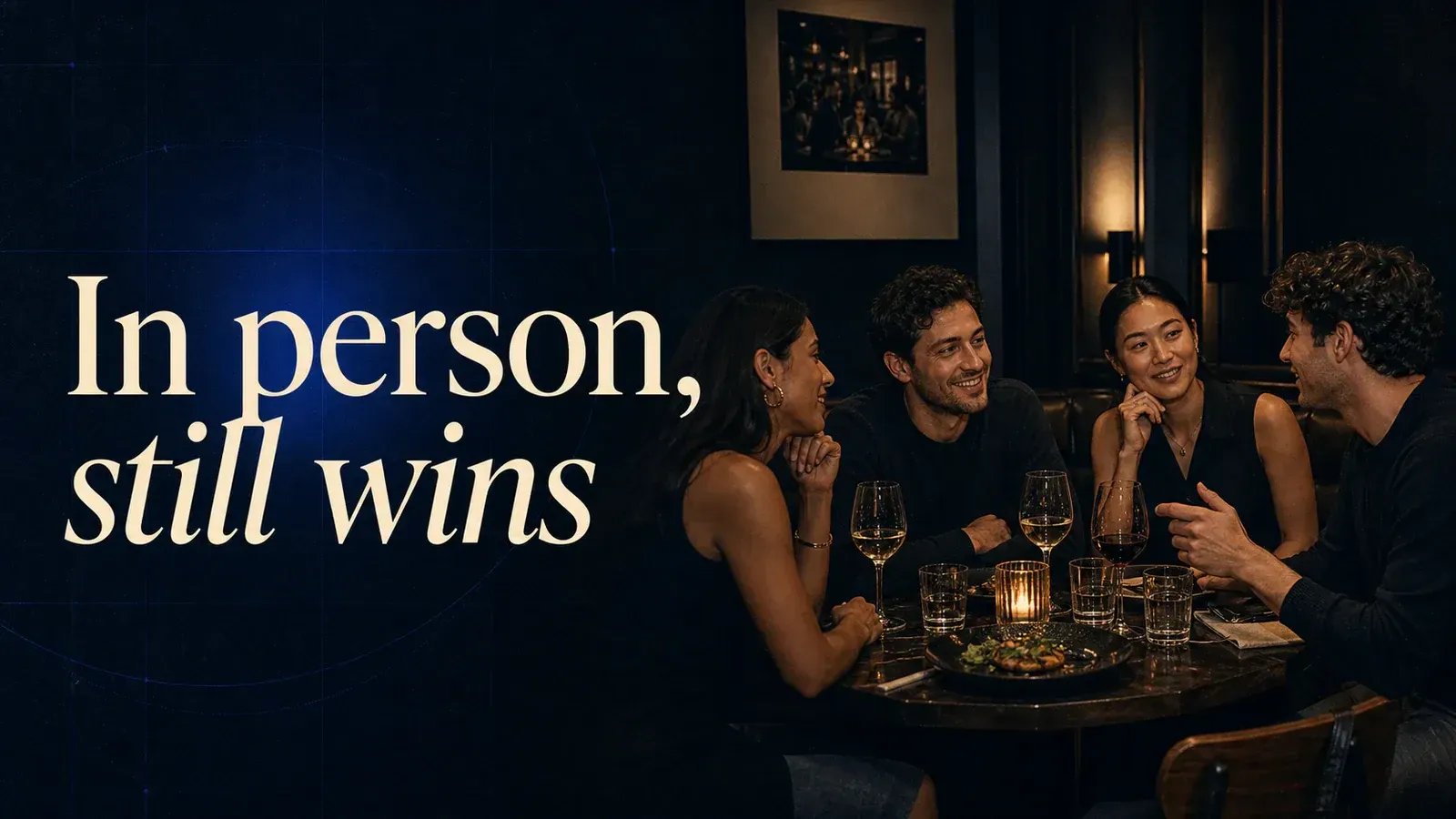
Every working relationship that ever mattered to you can be traced to a room. The hire that worked, the round that closed, the customer who became a partner. Somewhere along the line, two people sat across from each other and decided the other one was worth a bet. That moment is almost never made on a screen.
The remote era proved we could run companies from anywhere. It did not prove we could build them from anywhere. Operations are portable. Trust is not. After ten years of running fully distributed teams, even the most online founders quietly admit the same thing: the relationships that compound still get made in person.
Why digital networks plateau
Online networks expand fast and shallow. You can add a thousand connections in a year without once asking someone what they are working on this week. The graph grows. Trust does not. This is the central tension Mark Granovetter described in The Strength of Weak Ties. Weak ties are useful precisely because they are cheap, but they do not carry the weight of a strong tie. They flag opportunities; they do not sponsor you for them.
Asynchronous channels are also missing the thing that makes trust possible at all: real-time feedback. When you cannot see how someone reacts to your bad joke, your half-baked idea, or your inconvenient question, you also cannot tell whether they are someone you would actually want in your corner. So you do not risk much. The relationship stays at LinkedIn depth.
What you can only learn in person
The signals that decide whether someone is worth knowing rarely make it into a profile. They live in the unscripted seconds around a conversation. Call them the side channels of an interaction.
- How they treat people who cannot help them (the waiter, the valet, the assistant).
- Whether they listen, or wait to talk.
- What they laugh at, and what they do not.
- How they handle the moment when their phone buzzes and they choose to ignore it.
- Whether they remember what you said an hour later.
- How they recover when a story does not land.
None of this is in a LinkedIn summary, and none of it can be A/B tested. It is also the entire basis for whether you would refer them, hire them, fund them, or stand next to them at a wedding three years from now.
The trust-transfer framework
Trust between two people forms when three conditions hold at the same time. Use this as a quick diagnostic for any business relationship you are trying to build.
When all three are present, a relationship can carry a real ask within months. When any one is missing (which is the default state of a digital-only relationship), the relationship stays useful but never load-bearing.
When in-person matters most
Not every relationship needs a dinner. The question is whether you are trying to transfer something high-trust. A simple matrix.
How to choose in-person moments worth the calendar cost
If in-person is the highest-leverage channel for trust, the job is to design the moments so they actually do the work. A few practical principles.
- 1Choose a room size that supports real conversation. Six is the ceiling. Add a seat and the table quietly splits into two, a point we go deep on in Why small groups beat big rooms.
- 2Trust the curation. Who is at the table is the product; the venue is the wrapper. The composition question is covered in What makes a great dinner-table conversation.
- 3Optimize for the second hour. The first hour is small talk and credentialing. The part that actually compounds happens after the second drink.
- 4Keep the follow-up mutual. One-sided follow-up is the most common failure mode of a great night. We wrote a piece on this in From introductions to real relationships.
Common questions
- Does remote work prove we do not need in-person anymore?
- Remote work proves that production can be distributed. Relationship formation is a different problem. Most remote-first companies still cluster their high-trust moments (exec offsites, founder dinners, customer summits) into a handful of high-bandwidth in-person events per year. That cadence is the tell.
- What is the minimum in-person time to actually build trust?
- There is no precise answer, but a useful rule of thumb: three meals together, across at least two settings, inside a year. That seems to be the threshold at which most relationships earn the right to a hard ask.
- Is networking the same thing as building business relationships?
- No. Networking is a tactic, often optimized for breadth. Business relationships are a stock you compound over decades. The piece How ambitious people build better circles digs into the difference and why deliberate beats opportunistic every time.
The takeaway
You do not need a bigger network. You need a small number of people who would take your call on a Sunday. Those people are almost never made over a screen. They are made when you sit down, stay for the second drink, and decide the other person is worth the next dinner. Build for that, and the rest follows.