Curation
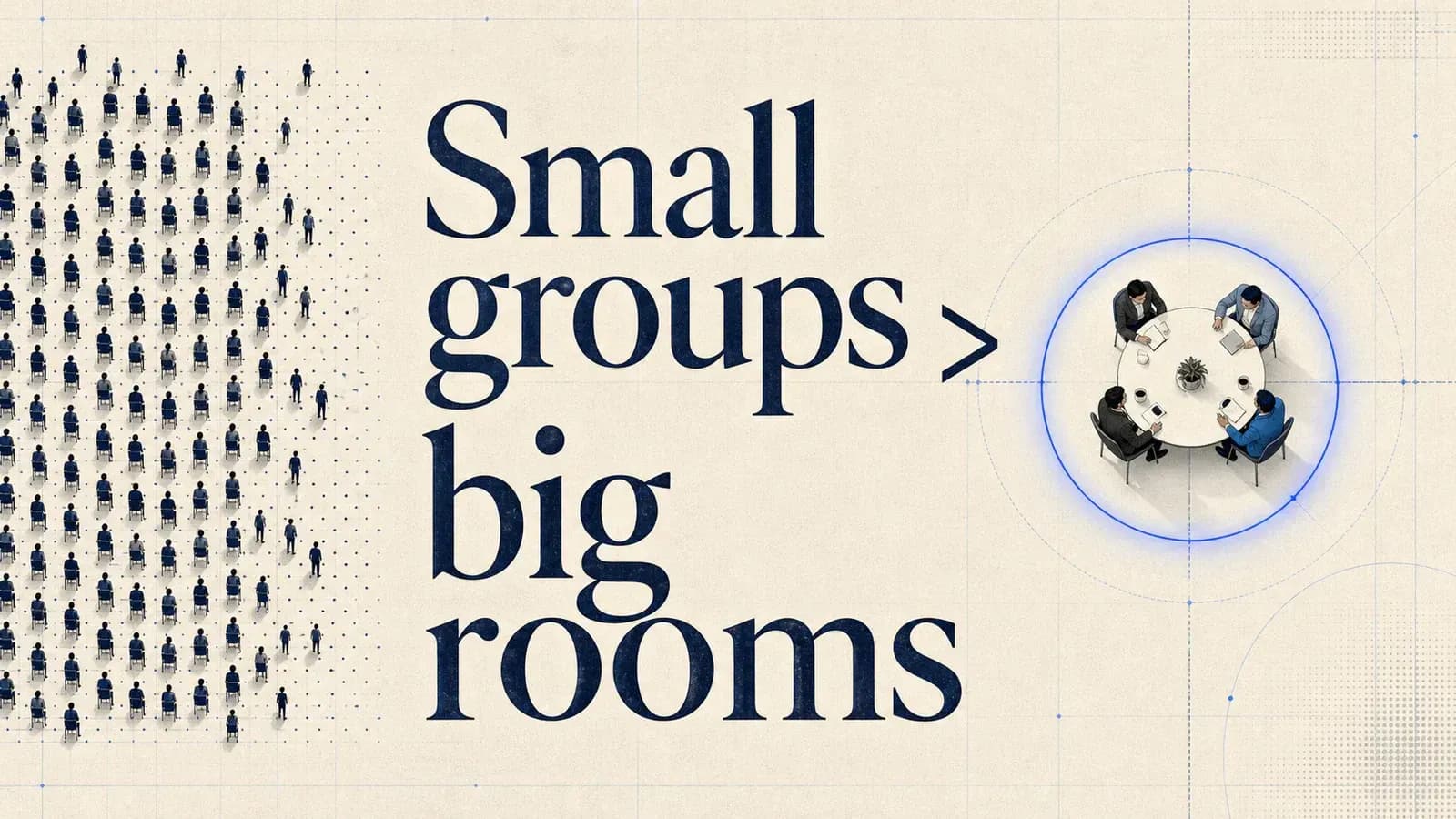
Why small groups beat big rooms.
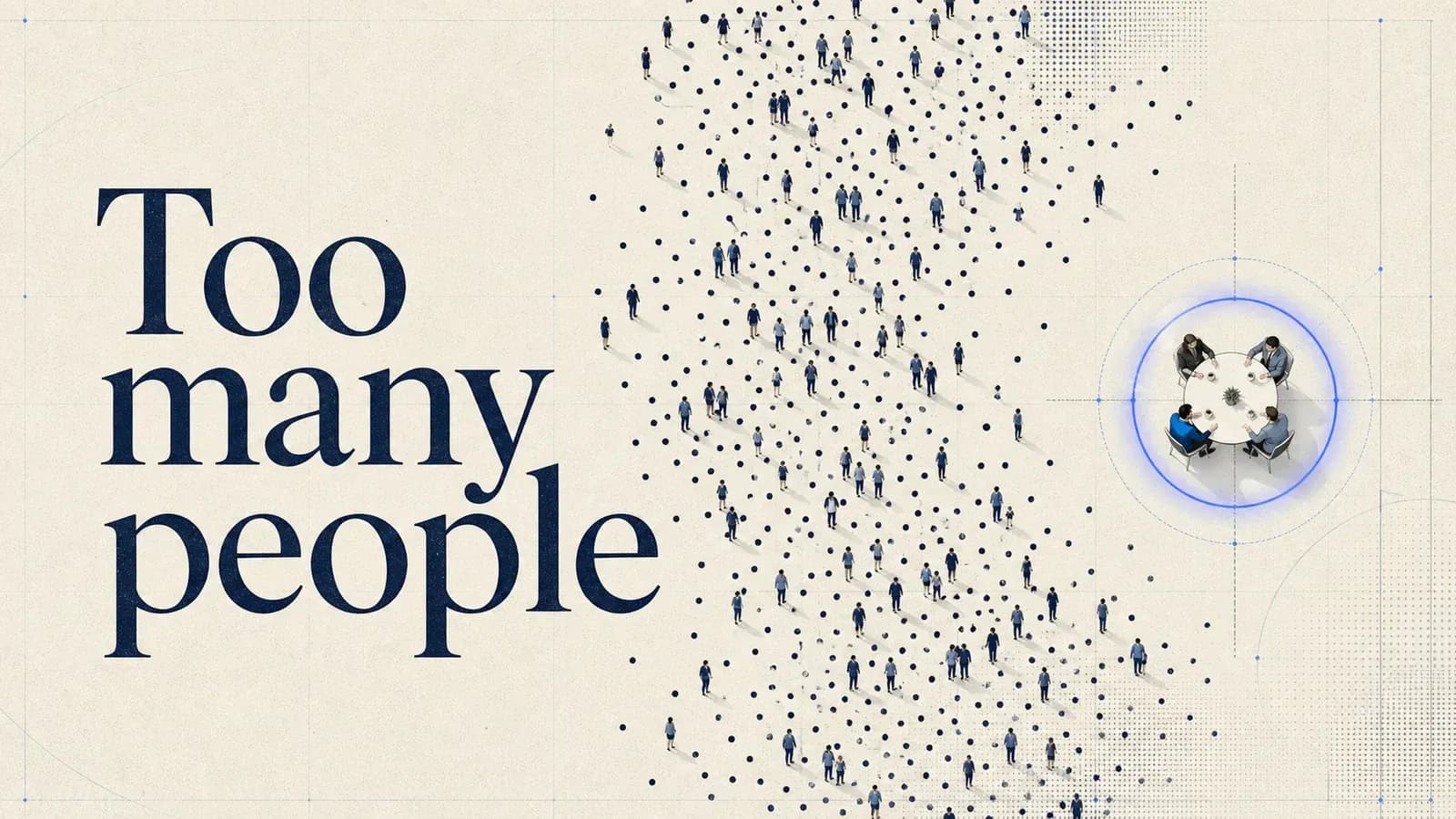
There is a reason every founder dinner you actually remember had fewer than ten people. It is not personal preference. It is cognitive math, and it shows up the same way for everyone who has ever tried to build relationships at scale.
Once you accept the math, a lot of what felt like networking advice (go to more events, work the room, expand the circle) flips on its head. The work of building real business relationships gets quieter, smaller, and significantly more effective.
Attention is a fixed resource
A person can hold roughly five to seven names and contexts in active working memory during a meal. Past that, you stop tracking individuals. Names blur. You miss the moment the person across the table says the thing you needed to hear because you were trying to remember whether the guy on your right runs an agency or a SaaS.
This is closely related to Dunbar's number, the anthropological observation that humans have natural ceilings on the size of stable social groups. The full Dunbar set is around 150 stable relationships, but the inner circle, the one where real reciprocity lives, is much smaller, somewhere between three and seven depending on the model. Dinner tables that exceed that ceiling do not just feel crowded. They stop functioning.
Why six is the size that works
A table of six gives you four things at once that no other size delivers.
- Enough variety that the conversation can pivot without recycling.
- Small enough that the whole table can hear every story.
- Large enough that one quiet guest does not crater the evening.
- Below the threshold at which the table splits into sub-conversations.
Below six, the conversation gets fragile. With only a handful at the table, one disengaged guest takes a quarter of the room down with them. Past six, geometry takes over: people physically cannot make eye contact across a table that wide, so they default to talking to whoever is next to them, and the dinner becomes two or three parallel evenings.
Group-size scorecard
Your room is too big if…
A quick diagnostic. If three or more of the following are true, the format is not going to do the work you wanted it to do.
- You cannot recall every name at the table the next morning.
- Two conversations happened in parallel for most of the night.
- The loudest person dictated the topic for more than half the evening.
- Someone left within the first hour without it changing the room.
- You are sending follow-up notes that are mostly generic.
- Nobody asked a real question past the second course.
The case for the dinner table specifically
A dinner table is a physical constraint that forces the right size. You cannot seat ninety people at a six-top. The constraint is the feature. It is also why members consistently tell us they remember a Thursday dinner the way they do not remember last year's offsite, which had bigger names, fancier food, and three times the marketing budget.
The mechanism is partly what we cover in Why the best business relationships still start in person and partly the curation question we get into in What makes a great dinner-table conversation. The size is what makes both of those mechanisms work at all.
Common questions
- What if I want to introduce more than six people?
- Run two tables. The temptation is always to expand the table because the list grew, and the temptation is always wrong. Two dinners at six is dramatically better than one at twelve. The marginal cost of a second dinner is much lower than the marginal cost of a worse conversation.
- Does a bigger room give people more options?
- It gives people more potential conversations and fewer real ones. Optionality is a feature in markets, not in trust formation. The point of a curated room is to take the optionality out, to remove the work of deciding who to engage so people can actually engage.
- How does this apply to virtual gatherings?
- Worse, not better. Video calls drop more bandwidth than in-person, so the size ceiling is lower, not higher. Most useful video gatherings cap at four to six. Past that, people mute, multitask, and the room collapses to the loudest two.
The takeaway
Stop trying to network at scale. The math does not support it. Return to the same small format, not necessarily the same people: one table, six seats, and people worth meeting. The relationships you remember in five years can begin across many different rooms of six.